
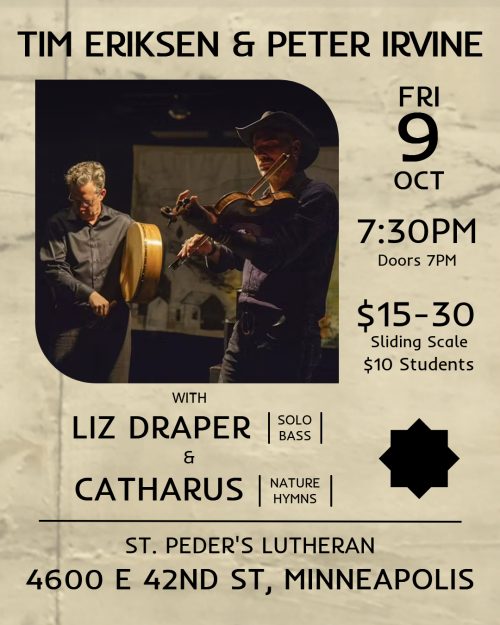
Join us 10/9 for a concert of traditional New England ballads and original compositions by Tim Eriksen & Peter Irvine from their latest album, Absence and her sister. The evening will open up with sets from Liz Draper and Catharus.
Friday, October 9th
7 Doors · 7:30 Music
$15-30 Sliding Scale · $10 Students
St. Peder’s Lutheran Church
4600 E 42nd St. Minneapolis
•—•—•—•—•
Tim Eriksen is an acclaimed singer, songwriter and multi-instrumentalist (guitar, banjo, fiddle, bajo sexto, kaval, bansuri) from Amherst, Massachusetts. “A compelling artist whose intense delivery and clarity of tone set him among the world’s finest folk practitioners” (Toronto Star)“, “Widely regarded as the best traditional American ballad singer of his generation” (BBC Radio). His scholarship on early American song has been published in Ethnomusicology and The Massachusetts Review, and his original songs have been covered by Joan Baez, Alison Krauss and Bonny “Prince” Billy.
Peter Irvine is a percussionist, composer, attorney, and stalwart Sacred Harp bass singer with a background in sound design for theater. A founding member of Cordelia’s Dad, he has collaborated with Eriksen across multiple projects, including their Bosnian ensemble Žabe I Babe and the New England magic lantern show Pumpkintown. His film work includes The Outwaters.
•—•—•—•—•
Upright and electric bassist Liz Draper’s music can be described as “classicaldoomfolkjazz,” a genre exemplified in her debut solo album “Meno” (Liatris Records, 2025). She is a 2021 American Composers Forum awardee for her solo work and has played with artists from Grammy-nominated slow-core band Low to the Balkan folk group Orkestar Bez Ime, Righteous Babe artist Pieta Brown, Grammy Award-winning Okee Dokee Brothers, and Smithsonian recording artist folk troubadour Charlie Parr. Liz is currently touring with 2 time Grammy-nominated songwriter Iris Dement.
•—•—•—•—•
Catharus is a vocal ensemble led by Kenan Serenbetz that explores the American hymn tradition. The group sings original hymns that contemplate and celebrate the divine as it courses through the natural world. By singing about specific beings and cycles in our Midwestern ecosystems, Catharus creates a symbolic language of bioregional imagery to articulate a theology centering our interdependence with all beings that share this land. Catharus creates rich harmonies rooted in centuries of sacred vocal music, from medieval polyphony to shape-note hymnody. The word Catharus comes from a genus of thrushes, a type of songbird known for their complex and ethereal songs.